Frank Josef Kriz
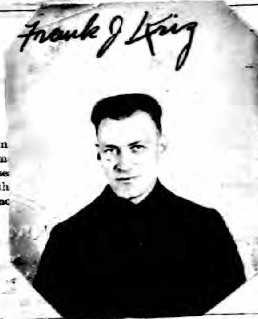
Frank Josef Kriz, our great-grandfather and gold-medal-winning gymnastics Olympian, was born 26 March 1894 in New York to parents Frank Kriz Sr. and Vincencia (Bacil) Kriz, both immigrants. Frank Sr. died in 1904, leaving Vincencia to raise five children. Frank Jr. grew up in Manhattan with his mother working as a cigar maker, according to census data, which was a common job for Bohemian/Czech immigrants in New York. To help the family out, Frank Jr., at the age of 16, worked as a driver for a dry goods store.
Frank Kriz Sr. and Vincencia Bacil
Our 2nd-great grandfather Frank Kriz Sr. was born in February 1862 in probably Bohemia (essentially what we know today as the Czech Republic), although various records also note Prague and Austria as his place of birth. His parents were Anton and Veronika (Jaks or Jakes) Kriz, according to New York City marriage records. Frank Sr. emigrated from Bremen port around 1881, judging from census data and passport application data.
Vincencia (variants: Winnie and Vincenza) Bacil was born in March 1872 in Bohemia to parents Joseph Jakes and Marie Pilc, according to New York City marriage records. She immigrated in either 1888 or 1890. Given the similarity of the last name “Jakes,” it’s possible that Frank and Vincencia were cousins.
Frank Sr. and Vincenza married on 12 March 1892 in Manhattan, shortly after Vincenza arrived in the U.S., possibly indicating they knew each other before immigrating. Together, they had six children. Tragically, they lost their first son in his infancy in 1893, also named Frank. Frank Sr. died at the young age of 41 on 2 June 1904 in Manhattan, and Vincencia remarried a man named Anton Bartunek in circa 1910. Together, Vincencia and Anton worked as cigar makers, continued to raise the Kriz kids, and had one additional son, Charles Bartunek.
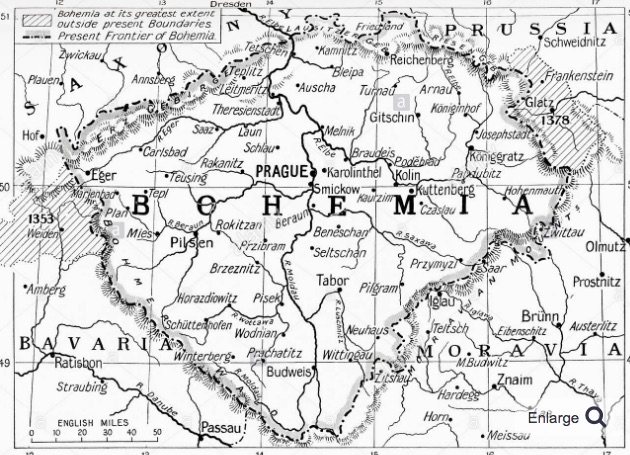
What is Bohemia and why did our ancestors leave?
Bohemia is an historical country of central Europe that was a kingdom in the Holy Roman Empire and subsequently a province in the Habsburgs’ Austrian Empire. From 1918 to 1939 and from 1945 to 1992, it was part of Czechoslovakia, and since 1993 it has formed much of the Czech Republic.During the years our ancestors left Bohemia, the reasons for emigrating were not based as much on religious injustice or political oppression, but rather economic problems. In addition to dwindling farmland and jobs, Bohemia issued a military draft of over 10 years in the army followed by 2-3 years in the standing reserve. Facing army service and little opportunity to work, many Bohemians became easily lured by letters from early emigrants, German shipping advertisements, and stories and advertisements in Czech newspapers about the free land and railroad jobs in the United States.
Excerpts from “The Czech Americans” by Stephanie Saxon-Ford, a Britannica article, Czechfriends.org article, and an online thesis of Czechs in America
New York served as the “entrance gate” to America for many Czech newcomers. For those who stayed, success in New York proved complicated and unlikely. Czechs who had sufficient resources could start a store or a restaurant and they could do very well. Many others worked only in second-rate jobs; in the worst case, they worked as cigar makers. The cigar-making industry in New York in the second half of the 19th century was predominantly occupied by Czech immigrants. Lots of them came from Sedlec, not far from Kutná Hora, in the 1860s, where they used to do the same job. They were offered higher wages in New York and that was the main reason why they decided to emigrate. Czech people also brought the pearl-button industry to America. Very soon after their arrival in New York, Czechs founded several pearl-button factories. Surprisingly, the Czech community in New York consisted of farmers too. Several Czech families founded a farming settlement called Bohemia in Long Island.
Frank’s incredible gymnastics talent
At the age of eight, Frank began gymnastic training at the Bohemian Gymnastic Association Sokol of New York City. Encouraged by his Sokol instructor, Joseph Gregor, Frank began competing at age 19 and dominated all the meets he entered, according to Encyclopedia of Ethnicity and Sports in the United States. While competing and training, Frank also worked as a fireman in New York City. According to the previously cited encyclopedia of sports, Frank built a horizontal bar behind his firehouse so that he could practice in his spare time!
What is a Sokol?
The Sokol movement is an all-age gymnastics organization first founded in Prague in the Czech region of Austria-Hungary in 1862 by Miroslav Tyrš and Jindřich Fügner. It was based upon the principle of “a strong mind in a sound body.” The Sokol, through lectures, discussions, and group outings provided what Tyrš viewed as physical, moral, and intellectual training for the nation. This training extended to men of all ages and classes, and eventually to women.Members of Sokol who emigrated from Czechoslovakia set up small Sokol groups abroad. This Sokol migration, for a variety of reasons, began even before Czechoslovakia became a nation in 1918, intensified as a result of the World Wars and the Communist suppression, and continues to this day. Bohemian, Moravian, and Slovak immigrants, and Czech-American citizens started the American Sokol Organization in St. Louis, Missouri in 1865, only three years after the first Prague Sokol.
Excerpt from a Wikipedia article
Gymnastics competitions and the Olympics
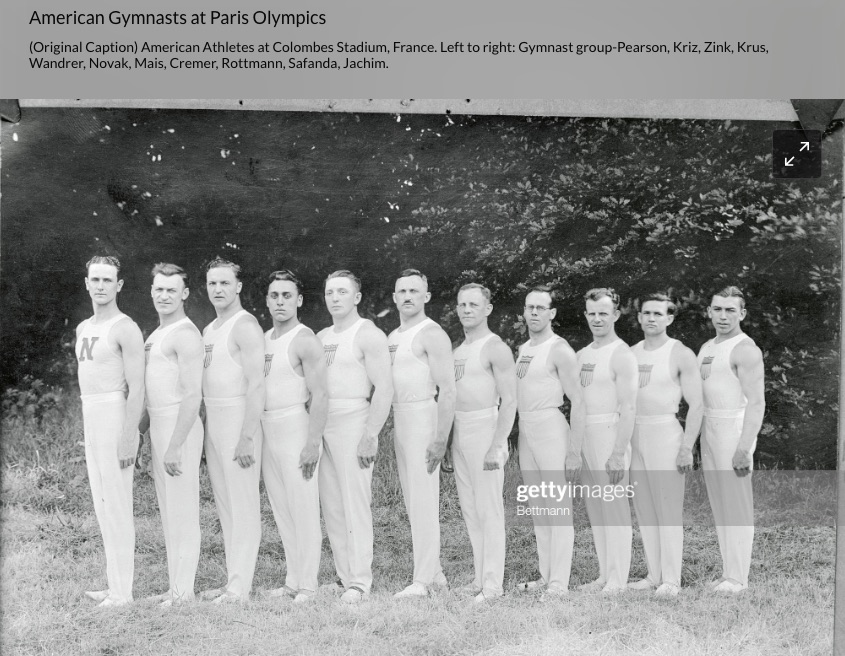
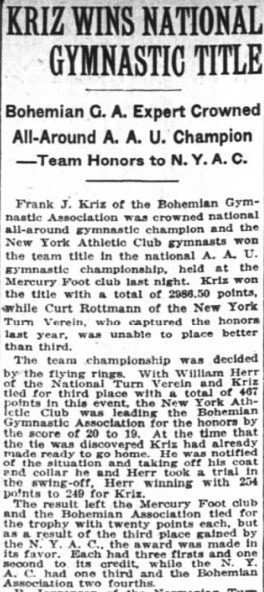
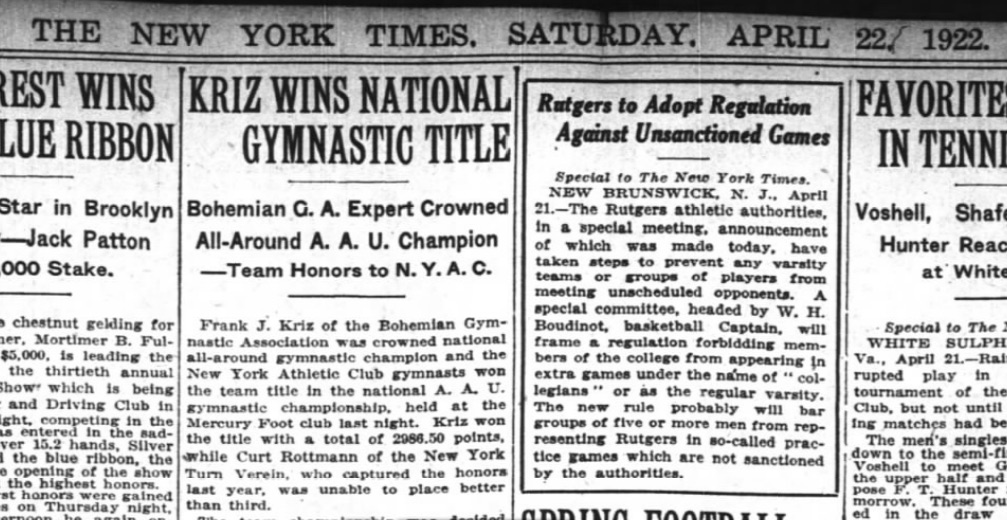
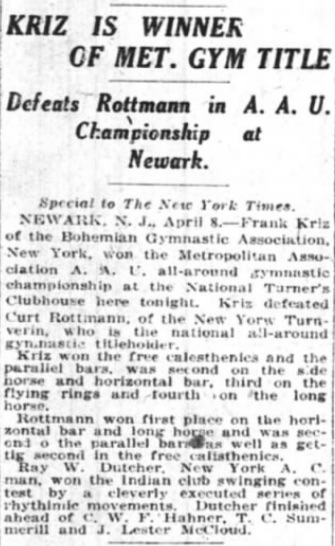
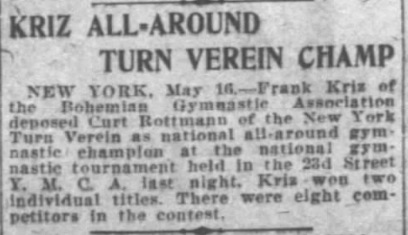
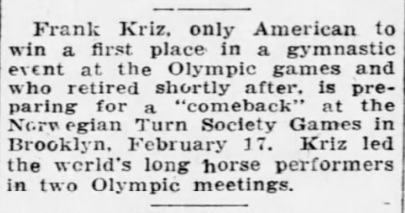
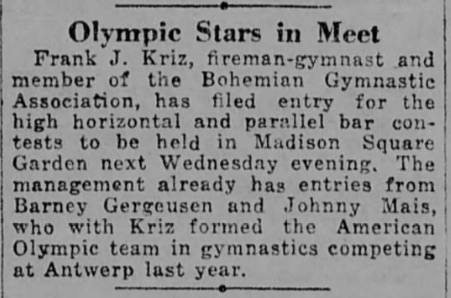
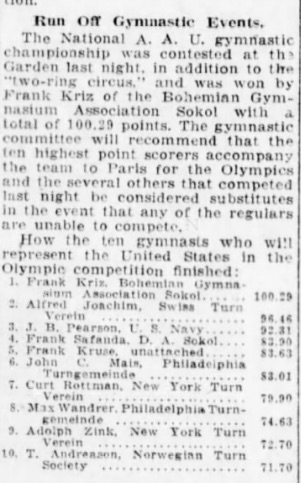
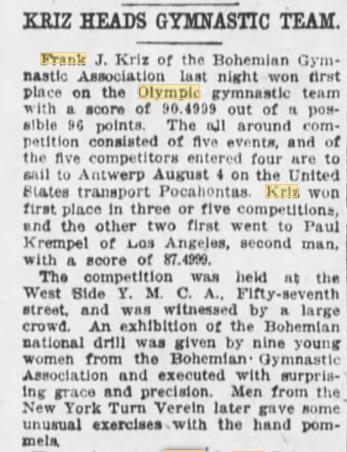
Frank had incredible talent for gymnastics, catapulting him into prestigious competitions. He won the Amateur Athletic Union (AAU) All-Around Championship in 1922 and 1924, and he took first place for the vault in 1918 and 1922, the parallel bars in 1922, and the horizontal bar in 1924. Frank represented the U.S. at the Olympic Games in 1920 (Antwerp, Belgium), 1924 (Paris, France), and 1928 (Amsterdam, Netherlands), winning first place at the Olympic tryouts in 1920 and 1924. At the 1924 games in Paris, he won the vault with the incredible score of 9.98, and placed sixth in the rope climb with a time of 8 and 2/5 seconds. His final score of 100.293 was nineteenth all-around, far ahead of the other Americans, even though he was thirty-one years old at the time.
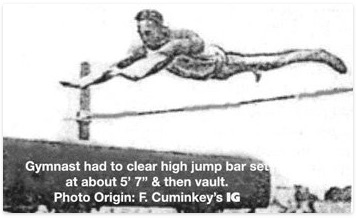
Frank’s 1924 gold medal in the horse vault was won in slightly unusual circumstances, as the event was not held according to strict international rules, but more closely resembled a high jump competition. A complete list of Frank’s Olympic scores in Antwerp, Paris, and Amsterdam can be found here.
Excerpt from a Washington Post article
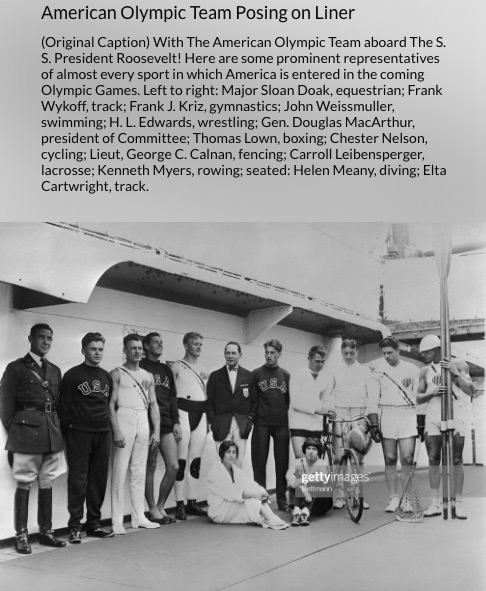
Ship passenger lists show Frank traveling to the 1920 Olympics in Antwerp aboard the SS Pocahontas, and back from Antwerp in September 1920 aboard the SS Finland. For the 1924 Olympics in Paris, Frank traveled aboard the SS Leviathan. In 1928, Frank traveled aboard the SS President Roosevelt from Amersterdam to New York, arriving 22 August 1928. General Douglas McArthur traveled with the Olympic team aboard the Roosevelt in 1928!
Josephine A. Kauders
Josephine A. Kauders was born in about 1897 in Bohemia (although documents also identify her place of birth as Prague, Austria, and Germany) to parents Leopold and Marie (Rehak) Kauders. At the age of three, Josephine immigrated to the United States with her parents and sister Bozena in 1901, according to census data. The family settled in New York, where her father worked as a bookkeeper.
Building a family life outside gymnastics competitions
Before his Olympics debut in 1920, Frank met and married Josephine (Joyce) Kauders on 16 February 1916 in New York. The couple was very young, with Frank still in his early 20s and Joyce just 19 years old! While still living in New York City (probably at 514 E. 82nd St.), they had the following children:
- Gladys (1916-1996) , married Leonard Fuchs in 1940
- Elaine, our grandmother (1921-2015)
The family eventually moved to Long Island City (Astoria) around 1924, where they lived at 369 13th St. Frank traveled quite a bit during these early years, spending several months in Europe for the Olympics in 1920, 1924, and 1928. The absences were likely hard on the family and may have contributed to Frank and Joyce’s divorce.
Frank and Joyce divorce
Between 1925 and 1928, Frank and Joyce divorced. Shortly after the divorce, Frank moved back in with his mother and her new husband, Anton Bartanek. He brought along Gladys and Elaine, and they all lived together in Queens until they moved to their own place (also in Queens). Both girls continued to live with their father for the next 12-15 years. As of 1940, Frank still worked as a fireman and had a lodger living with the family named Irene Barnnan (variant: Brennan), who Frank appears to have have later married as his second wife. According to the New York Marriage License Index, Frank Kriz and Irene Brennan received a marriage license on 16 January 1947.
Unfortunately, we lose track of Joyce after 1925. Any family info here???
Frank died in New York at the age of 60 on 11 January 1955, although we are unable to locate his grave. Frank was the first American gymnast to medal at an Olympics held outside the United States and that record stood until 1976, when Peter Kormann took bronze in the floor exercise.
The below collage of various New York newspaper articles highlights Frank’s impressive gymnastics accomplishments between 1920 and 1926:
 Clare Family History