Our great-grandfather Xavier (variant: Ksawery, Ksawer) Francis Widelski was an entrepreneurial baker, who immigrated from Poland at the age of about 22. First establishing himself in Chicago, he met his bride Rose Lazar, and then together they moved to the idyllic town of Michigan City, Indiana, where the family and its future generations thrived.
Xavier F. Widelski
Xavier was born 19 November 1883 in Posen, Poland to parents Wawrzyn (Lawrence) Widelski and Izabela (Isabelle) Klichowska (variant: Klichowski).
Going back as far as we can:
Our 2nd-great grandparents Lawrence and Izabela married in Cienin Kościelny in 1873, according to http://poznan-project.psnc.pl/. Furthermore, Lawrence’s parents, our 3rd-great grandparents, were named Bogusław (Bogumił) and Konstancja Białkowska, who were married in Sławsk in 1844. And Izabela’s parents, our other 3rd-great-grandparents, were Petronela Skowronskich and Jakub Klichowski. During the 19th century these territories were in Russian-controlled Poland.
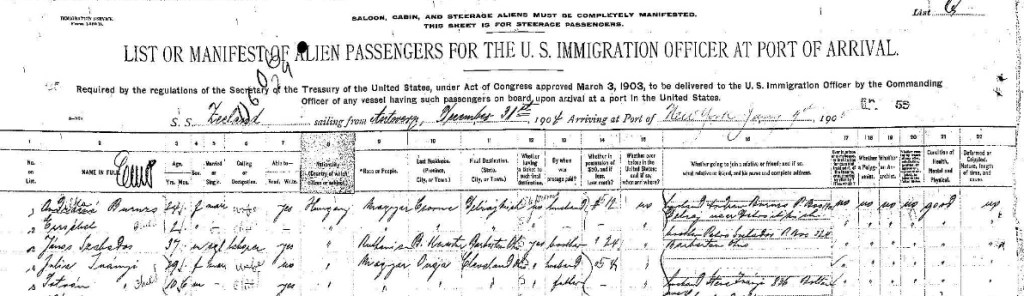
Xavier immigrated to the United States early in the 1900s probably aboard the ship S.S. Zeeland in 1905, which departed Antwerp and arrived in New York at Ellis Island. On the passenger list, there was a Kazmierz Widelski, (age 26), who was listed as a baker from Russia, of Polish heritage, last living in the village of Pokaje. This village belonged to the parish of Cienin Kościelny. His destination was listed as S. Chicago. The below graphic shows the passenger manifest with probably our ancestor’s entry at the very bottom.

During the time of Xavier’s departure, Poland was essentially divided into three different parts, German/Prussian-, Austrian-, and Russian-controlled (where we believe Xavier came from) sectors. It was only after 1900 that Polish emigrants from the Russian and Austrian sectors outnumbered German/Prussian Poles leaving their homeland. In the Russian sector, contributing factors for leaving included economic hardship and suppression of the Polish language and culture.
The overall magnitude of the tidal wave of emigration can be seen in U.S. Census figures. In 1870, 40,000 Poles lived in the U.S. By 1900, over 668,000 people reported having both parents born in Poland and about 1,400,000 persons reported having one parent born in Poland.
Rose Lazar
Our great-grandmother Rose Lazar was born 4 September 1887 in Chicago to hard-working immigrant parents Jacob F. Lazar and Frances Zaja. Rose’s parents (our 2nd-great grandparents) probably immigrated from the German-controlled area of Poland, judging from census data that listed their birth locations as “Poland (Germany).” Rose’s mother tragically died young, probably in 1906 at the age of 42, according to Cook County records. With this family loss, Rose stepped in to care for her father and family. Even after marriage, Rose’s father and one brother continued to live with her for several years.
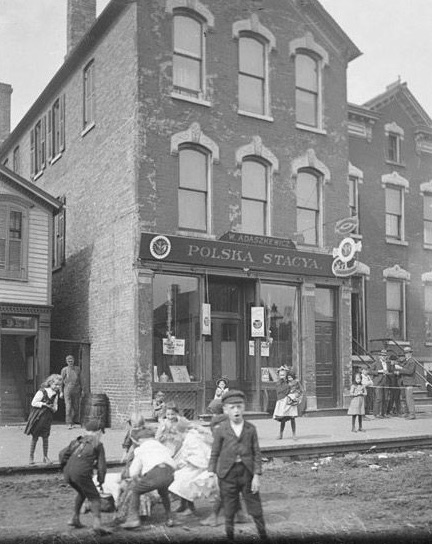
Rose grew up in South Chicago. Her father worked as a laborer at a rollmill, while her mother stayed home with Rose and her younger brother John. It’s possible that Rose’s father worked at North Chicago Rolling Mill, which was a steel mill established in 1880 on the west bank of the Calumet River at Lake Michigan and referred to as “South Works.” Judging from the census data, Rose’s maternal grandmother might have lived next door as her neighbors were Johana Zaja, age 58, and Vicenty Zaja.
Rose lived with her family in the thirty-third district of south Chicago, an area which experienced significant overcrowding and sanitation issues during the early 1900s. Dominic Pacyga’s book Polish Immigrants and Industrial Chicago: Workers on the South Side, 1880-1922 provides an illustrative description of that area during Rose’s time there:
The Thiry-third Ward neighborhood in 1900 covered more than 13,000 acres, but the bulk of the population lived on less than one fourth the area. The homes of the Polish workers stood crowded close to the mill gate of the Illinois Steel Company. An 1890 survey found 3,558 dwellings in the neighborhood, with an average of 7.26 people per unit. Many houses contained more than one family and flats were numerous. In the area between 85th and 93rd streets, the mills and Exchange Avenue, the city raised the grade of the streets causing some of the homes to rest several feet below street level and therefore create basement flats. Several of these properties became hard to drain properly, and pools of stagnant water developed in the area, leading to frequent outbreaks of typhoid fever. Observers considered the general area as one of the most unsanitary in Chicago. No sewer system existed in large parts of South Chicago in 1900, and outdoor vaults and indoor water closets emptied into cesspools that endangered the general health.
Edited excerpt from Pacyga’s book
Starting a large family in south Chicago
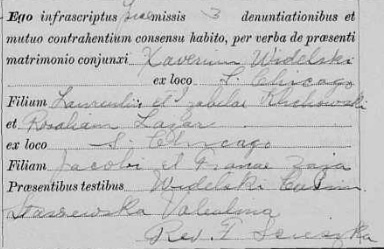
Xavier and Rose met in Chicago in the early 1900s, probably socializing in the same somewhat insular Polish-American community circles. Xavier (age 24) and Rose (age 22) were married 30 June 1909 at Immaculate Conception (2944 E. 88th Street, Chicago, Illinois).
Over the next ten years, Xavier and Rose became proprietors of a bakery, and together had at least seven children, one of whom appeared to passed away early. The Widelski children included:
- Edmond (1910- 1989)
- Esther (1913- ); probably died in infancy
- Henry, our grandfather (1915-1966)
- Irene (not a twin) (1915-2006)
- Dolores (about 1918-2004)
- Clara (1919- 1977)
- Angeline (about 1921- 2008)
Moving out of the city to Indiana
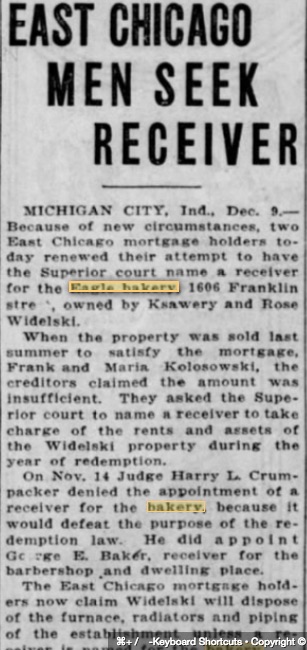
Xavier and Rose raised their large family in the crowded conditions of South Chicago. They also housed Rose’s father Jacob and her brother John P. It’s possible that the couple sought more space for their family when deciding to move outside Chicago to Michigan City, Indiana in around 1930. Business opportunities might also have influenced the family’s relocation. By 1932, Xavier and Rose had already established their own bakery in Michigan City named Eagle Bakery. This was a true family business with most of the children working at the bakery, according to census data. Unfortunately, the bakery endured economic hardship and Xavier and Rose appeared to sell the business (see article to the right). However, according to the 1940 census, Xavier and Rose still owned and ran Eagle Bakery, so it appears they found a way to keep the business!
In her spare time, Rose became involved in a Rosary Society, League of Sacred Heart, Polish Women’s Alliance of America, and Royal Neighbors of America, according to her obituary. Clearly, Rose was a dedicated Catholic, charitable woman, and proud of her Polish heritage. Also dedicated to honoring his heritage, Xavier was an active member with the Polish Business and Professional Club and the Polish National Alliance.
After suffering from an illness for a year, Xavier died 8 April 1951 at the age of 67. Rose died 22 March 1962 in LaPorte, Indiana and is buried at St. Stanislaus Cemetery with her husband. After Rose’s death, her son Edmond took over Eagle Bakery.
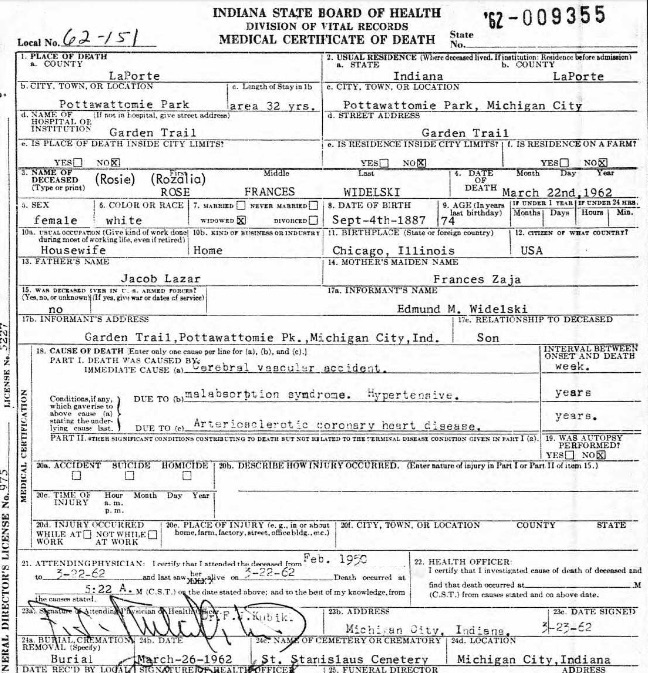
Rose’s death certificate 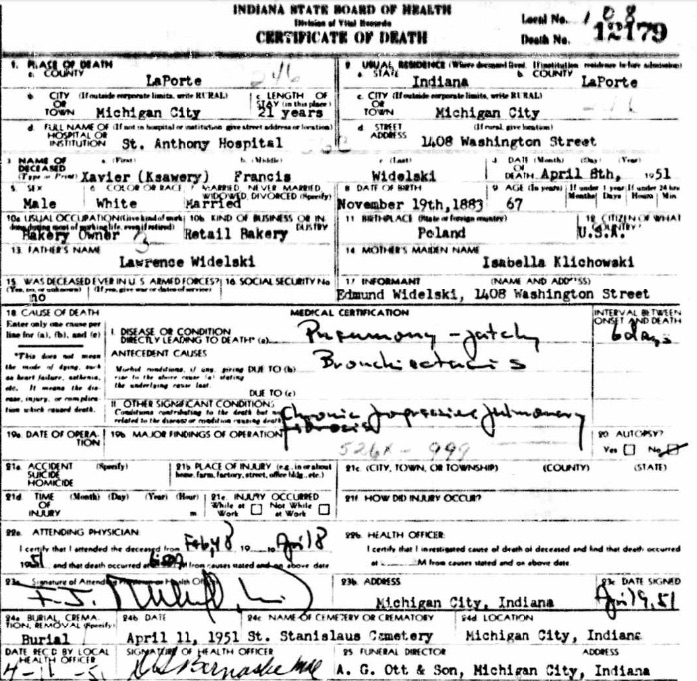
Xavier’s death certificate
 Clare Family History